
 By
By 
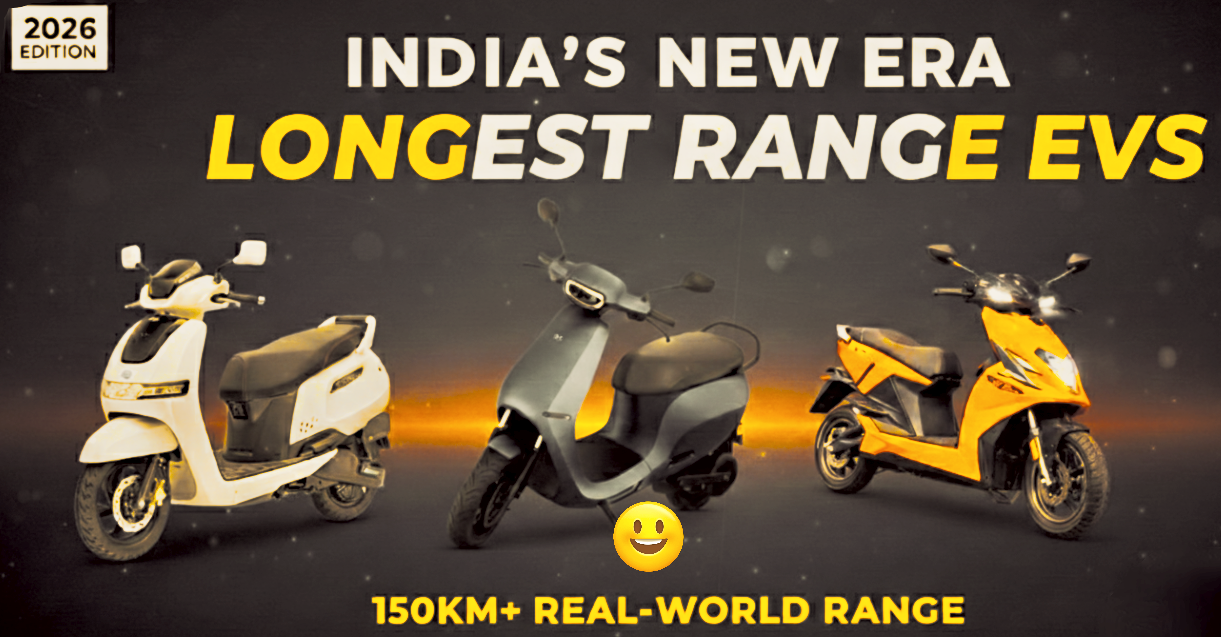
The Indian electric scooter market has matured significantly in 2026. We are no longer talking about exaggerated lab figures — today’s premium EVs are genuinely capable of crossing 150 km in everyday city riding. Thanks to bigger battery packs, smarter battery management systems, and improved motor efficiency, range anxiety is quickly becoming a thing of the past.
Among the standout performers this year are the Simple Ultra (6.5 kWh), Simple One Gen 2 (5 kWh), TVS iQube ST (5.3 kWh), and the Ola S1 Gen 3 lineup, including S1 Pro Plus, S1 Pro, S1 X Plus, and S1 X variants with 4–5.2 kWh battery options.
IDC Numbers vs. Real-World Performance
Most EV brands highlight IDC (Indian Driving Cycle) figures. While IDC provides a standardized testing benchmark, it doesn’t fully represent real traffic conditions — such as stop-and-go riding, carrying a pillion, or dealing with summer heat.
In practical use, scooters with battery capacities of 4 kWh or more are typically able to cross 150 km comfortably. However, battery size alone is not enough. Efficient PMSM motors, regenerative braking systems, and advanced thermal management play a major role in ensuring consistent performance.
The models listed here don’t just promise range — they deliver it on busy urban roads.
1. Simple Energy – Built for Long-Distance Riders
Simple Energy has focused heavily on high-capacity battery packs.
Simple Ultra (6.5 kWh)
With one of the largest battery packs in the segment, it claims around 400 km IDC. In realistic city usage, riders can expect well above 200 km per charge, making it ideal for heavy commuters.
Simple One Gen 2 (5 kWh)
A more practical option for daily use, offering a claimed 265 km IDC. In actual riding conditions, it delivers approximately 170–180 km reliably.
2. Ola Electric – The Gen 3 Platform Upgrade
Ola’s Gen 3 architecture focuses on improved battery chemistry and efficiency optimization.
Ola S1 Pro Plus (5.2 kWh)
The flagship model offers around 320 km IDC and delivers roughly 170–185 km in regular riding modes.
Ola S1 Pro / S1 X Plus / S1 X (4 kWh variants)
With IDC figures around 242 km, these models consistently provide real-world ranges above 150 km when ridden sensibly in city conditions.
3. TVS iQube ST – Trusted and Consistent
The TVS iQube ST 5.3 kWh takes a more conservative and reliability-focused approach. With an IDC rating near 212 km, it is widely appreciated for accurate distance-to-empty readings and predictable performance. Real-world range comfortably crosses the 150 km mark due to balanced power delivery and strong thermal control.
Why 2026 Makes EVs a Practical Financial Choice
Beyond range, operating costs make electric scooters even more attractive. A typical petrol scooter can cost ₹2.5 to ₹3 per kilometer to run, while electric scooters in this category operate at roughly ₹0.25 per kilometer.
In addition to fuel savings, EVs eliminate routine expenses like oil changes, spark plug replacements, and exhaust maintenance. For many daily commuters, the higher upfront cost can be recovered within 1.5 to 2 years of regular use.
Final Thoughts
Electric scooters in 2026 are no longer experimental alternatives — they are practical, long-range machines suitable for everyday commuting. With 150 km+ real-world range now achievable, the biggest hesitation for many riders has finally been addressed. The shift from petrol to electric is not just environmentally responsible — it’s economically logical.
1 Comment